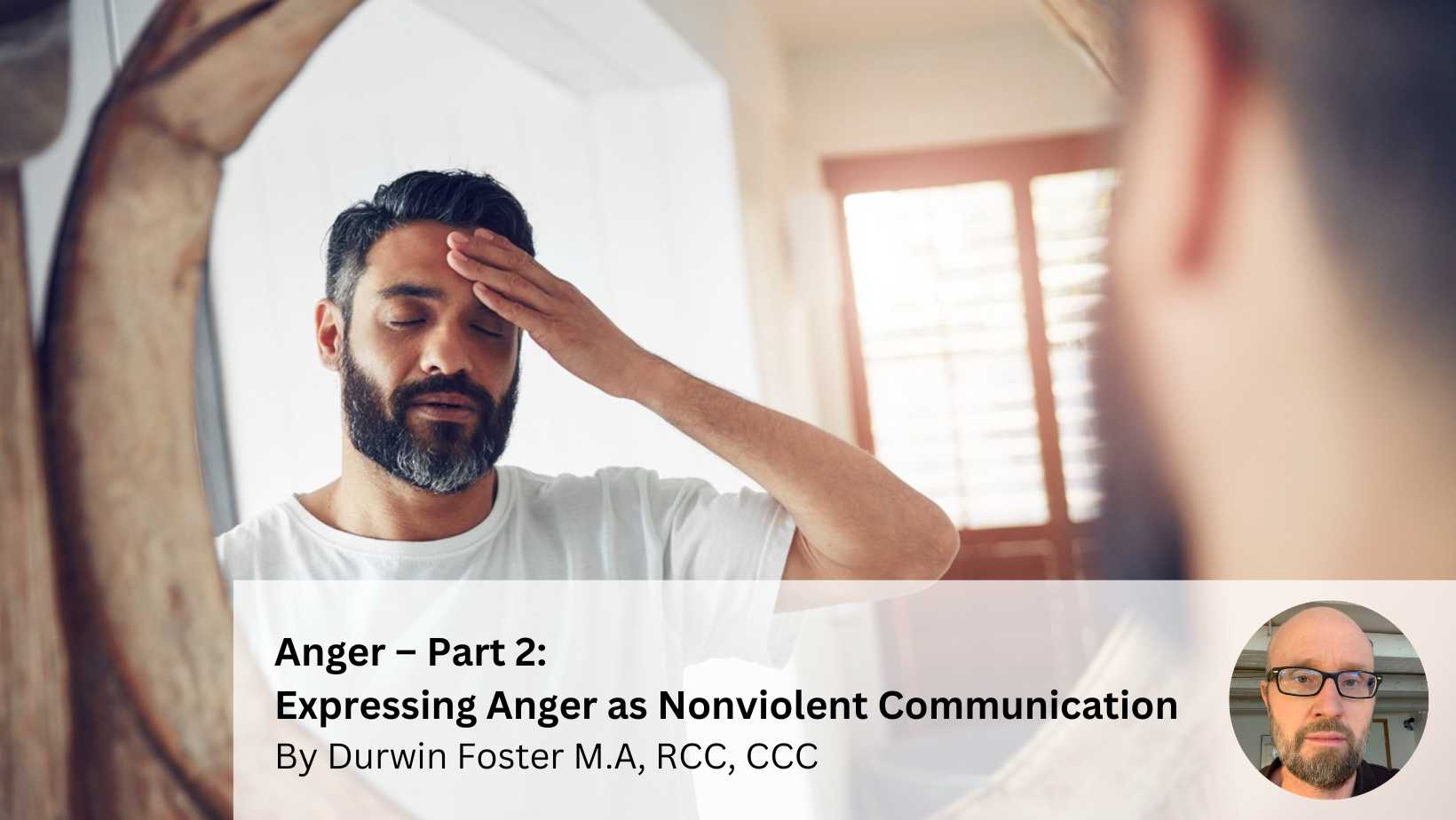

Expressing Anger as Nonviolent Communication
Expressing Anger as Nonviolent Communication
By Durwin Foster, M.A.
Registered Clinical Counsellor
Part 2
In the first part of this article, I explained the important difference between feeling anger and acting out with aggression. While anger is a natural emotion that can be important to fully feel, acting out with aggression can lead to unintended negative consequences. If you haven’t read part 1, I encourage you to do so here. In this article, we’ll explore how to turn anger into a clear expression of either assertiveness or need using a method called Non-Violent Communication.
Is your anger hiding something more vulnerable underneath?

In psychology, we sometimes identify emotions as either primary or secondary. Primary emotions are the core emotion being felt. Secondary emotions are reactive emotions that sit on top of primary emotions. Secondary emotions are often present because the primary emotion(s) are too vulnerable or uncomfortable to feel directly. Anger is a common secondary emotion.
Being able to recognize whether or not anger is primary, or instead is a reaction towards more vulnerable feelings like envy, fear, shame or potentially even sadness, is an important skill to develop.
This skill is important because anger can look like strength on the outside; therefore, we sometimes display anger when what’s really happening is that we are feeling something more vulnerable or less socially acceptable, “deeper down”. By finding out what is the primary emotion we are feeling, and then dealing with that, secondary anger often lessens.
How to Find The Primary Emotion You are Experiencing
You can learn to find out more about what emotion is primary in the following way:
The next time you feel angry, try asking yourself if there is more going on. For example, you can inquire “Could I really be feeling embarrassed or ashamed?” Or, “Could I really be feeling afraid or sad?” And, “could I really be feeling envious or jealous?” While asking these questions, you want to be tuning into the felt sense of your body. Even right now, you might take a moment to simply feel your inner experience right now. And by the way, there are no exact answers here, simply go with what you come up with.
If anger still turns out to be your primary emotion, then you will deal with it by learning to be assertive — not aggressive — as described below. If anger turns out not to be your primary emotion, then what you do is switch your focus to what is the primary feeling and work with that. Since each of the other emotions we discussed have different ways of resolving them, the “how to’s” for each of them will need to be discussed elsewhere. That said, you have already made a big win in clarifying what you are really feeling. Knowledge is power.
Being Assertive In Order to Protect the Boundary or Meet the Need
If you clarify that anger is your primary emotion, it’s important to learn how to communicate assertively.
The model I have found most helpful in my work on this is called nonviolent communication. Providing a way to communicate that is respectful of both self and other, “nvc”, as it is often abbreviated, includes 4 steps: (1) Observation, (2) Feelings, (3) Needs, (4) Request. These are as follows:
Step 1 – Observation
As best you can, separate out what is observable in the situation that is bothering you, from your interpretations or judgements about it. When your communication is as close as possible to an objective description of a situation — what I sometimes call the “video camera view” – it’s both easier for the other person to hear without reacting, and harder for them to avoid the truth of what you are saying. The nonviolent communication approach provides a sentence stem to make this easier, e.g “When I see….”, or “When I hear….”
Step 2 – Feelings
Distinguish what you are feeling from what you are thinking, and share what you are feeling. When you risk speaking to your authentic feelings, you are simultaneously inviting a more vulnerable response from the other person. If they respond authentically in turn, then emotional intimacy starts to deepen between you. A list of feelings can be found here.
Step 3 – Needs
Emotions can be thought of as “energy-in-motion”, and what gets us moving? Our needs do. So the third step of recognizing and then expressing what it is we need from this interaction is crucial. Classically viewed hierarchically, although more recently re-formulated as “forms of integration” (see reference below), our needs include physical safety, relational connection and psychological self-esteem, exploration and creativity, and love and purpose. With these in mind, identify what is your need right now. A list of needs can be found here.
Step 4 – Request
Make a request that will help meet the need. When formulating a request that will help you meet your need, it is important to distinguish between what is a request versus what might be perceived as a demand. The difference between a request and a demand lies mostly in the tone and volume of your voice. Using a gentle tone of voice at a relatively low volume works best. For example, “Would you be willing to….”
In conclusion, taking the time to inquire into what we are most authentically feeling, as well as learning to communicate assertively when anger is verified as our primary emotion, are two skills that will make a difference in reducing problem anger.
References
https://www.elephantjournal.com/2018/07/the-buddhist-secret-how-to-transform-our-anger-into-clarity/
Nonviolent Communication: A Language of Life By Marshall B. Rosenberg, PhD